
Where Did All My Hard-Earned Money Go?
You write a massive check every single month toward your loan. You make every payment on time and sacrifice small everyday luxuries to stay consistent.
Yet, when you open your annual loan statement, your heart sinks. The remaining balance has barely nudged downward after a full year of hard work.
It feels like you are trapped on a financial treadmill. You keep running and spending your hard-earned income, but your actual debt balance stays almost entirely frozen in place.
Where did all that money actually vanish? You are not losing your mind, and your bank is not secretly stealing from you.
You are simply experiencing the confusing mechanics of a standard loan amortization schedule. Once you understand how this system works, you can regain complete control over your money.
Deciphering the Amortization Code
An amortization schedule is a complete table that outlines every single payment you will make over the life of a loan.
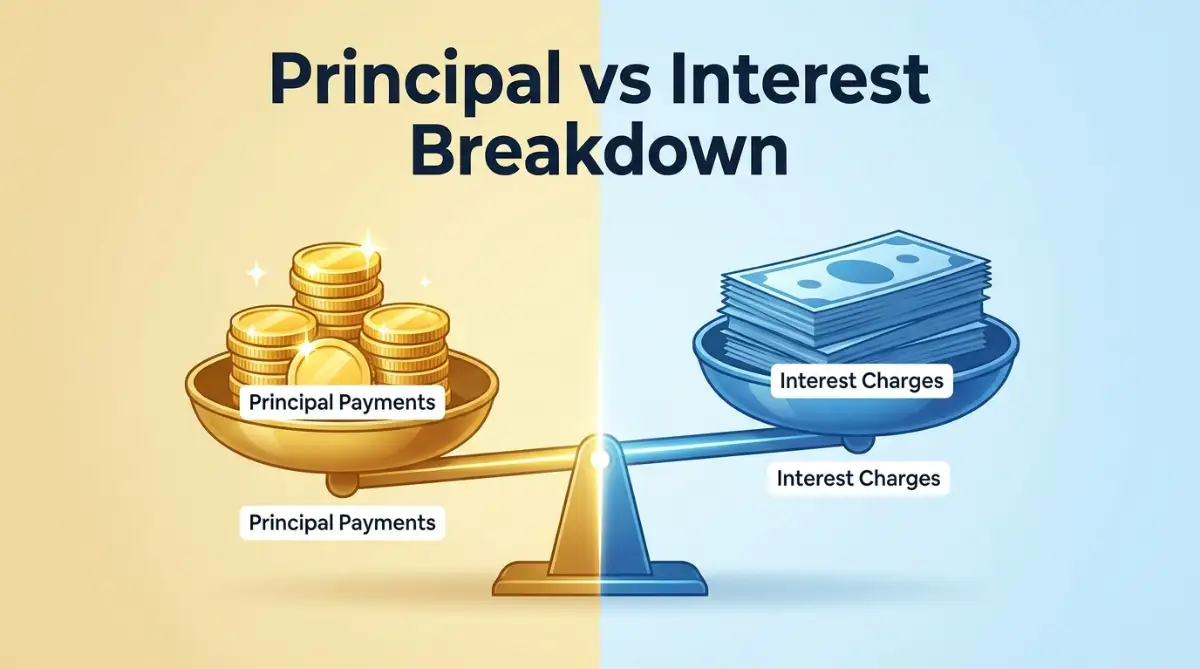
It breaks down each monthly payment into two distinct buckets: principal and interest. The principal bucket pays down the actual debt balance you borrowed, while the interest bucket pays the lender for lending you the cash.
At the very beginning of your loan, the lender calculates interest based on your full balance. Because your total balance is huge, the interest charge for that month is also massive.
As a result, almost your entire monthly payment gets swallowed up by interest charges during the first few years. Only a tiny slice reaches your principal balance to lower what you owe.
Early Loan Phase: Interest Heavy (80%) + Principal Portion (20%)
Late Loan Phase: Interest Small (10%) + Principal Portion (90%)
Over time, this heavy ratio gradually flips. As your total principal balance shrinks, the calculated interest drops every month, allowing a bigger chunk of your money to attack the actual balance.
The Mathematical Engine Behind Your Monthly Statement
To see how this works in real life, consider a standard mortgage or personal loan scenario. Imagine you take out a loan for $200,000 with a fixed interest rate of 6% over a 30-year loan term.
Your fixed monthly payment for principal and interest will be roughly $1,199 every month.
Here is how your money gets split across different stages of that loan:
Month 1: The Initial Shock
- Total Payment: $1,199
- Interest Paid to Bank: $1,000
- Principal Paid Down: $199
- Remaining Loan Balance: $199,801
Out of your $1,199 payment, only $199 goes toward reducing your actual debt balance. The bank keeps the remaining $1,000 as their fee for letting you borrow the money.
Month 180 (Year 15): The Tipping Point
- Total Payment: $1,199
- Interest Paid to Bank: $605
- Principal Paid Down: $594
- Remaining Loan Balance: $120,410
Halfway through the term, your monthly payment amount remains identical, but the division changes dramatically. Now, nearly half of your check directly lowers your debt.
Month 300 (Year 25): The Final Sprint
- Total Payment: $1,199
- Interest Paid to Bank: $211
- Principal Paid Down: $988
- Remaining Loan Balance: $41,215
Near the end of the loan, almost your entire monthly check goes toward destroying the final balance, while interest drops to a minor fee.
Common Myths vs. Realities of Loan Amortization
Understanding the real facts behind loan payments can help you avoid costly mistakes.
Why the System Is Built This Way
Lenders organize amortization schedules to protect their financial investment up front. Lending money carries risk, so banks collect their profit early in the arrangement.
This setup ensures that even if you sell your home or refinance your loan after five years, the lender has already collected a major portion of their total profit.
This mechanism is not illegal or predatory; it is simply standard financial math based on compound interest equations.
When you understand this math, you no longer have to sit back and watch your money vanish into interest charges. You can start using the system to your own advantage.
Pro Tip: The Power of Targeted Principal Payments
When you make an extra payment, ensure your lender applies it strictly to the Principal Balance rather than future interest payments. This simple action permanently lowers the balance that interest is calculated on for all future months.
Practical Ways to Outsmart Your Amortization Schedule
You do not have to accept the slow pace of a standard amortization schedule. Here are simple, effective ways to rewrite the math in your favor right away.
1. Make One Extra Payment Each Year
If you make 13 monthly payments instead of 12 within a single year, you can slice years off a long-term loan.
By applying that extra payment directly to the principal balance, you skip ahead on your amortization chart. This permanently wipes out thousands of dollars in future interest charges.
- Standard 12 Payments Per Year: Takes full loan term duration to complete.
- 13 Payments Per Year (1 Extra): Saves 4 to 6 years of interest payments.
2. Round Up Your Monthly Check
You do not need thousands of dollars to make a noticeable dent in your debt. Rounding up your monthly payment offers an easy, low-stress way to accelerate progress.
If your required loan payment is 1,110∗∗,considerroundingyourpaymentupto∗∗ 1,200.
That small extra $90 goes directly toward principal. Over time, those modest additions stack up, shortening your overall payoff timeline.
3. Switch to a Bi-Weekly Payment Plan
Instead of paying once a month, split your monthly payment in half and pay every two weeks.
Because there are 52 weeks in a year, you will make 26 half-payments, which equals 13 full payments each year.
This automated routine lets you make one extra payment per year without disrupting your monthly spending plan.
How to Read Your Amortization Table
Every loan agreement includes a full amortization schedule. Here are the four key columns you need to look for:
- Beginning Balance: The total principal you owe at the start of the monthly cycle.
- Principal Portion: The exact dollar amount from your payment that shrinks your balance.
- Interest Portion: The cost charged by the lender for that specific month.
- Ending Balance: The updated total debt you owe after the payment is processed.
Monitoring these numbers helps you track your progress accurately. Watching the principal column grow each month provides clear proof that your debt payoff strategy is working.
Taking Your First Step Toward Total Debt Freedom
Understanding your loan amortization schedule completely changes how you view your debt. It strips away the mystery and turns a scary, mountain-like loan balance into a clear roadmap you can master one step at a time.
You no longer need to sit back and wonder where your hard-earned paycheck goes after every payment. You now hold the exact blueprint to track every single dollar with total clarity and confidence.
Take back control of your financial story today. Open your latest loan statement, examine your remaining balance, and see how even small extra principal payments can shave years off your payoff timeline.
- Inspect Your Numbers: Know your exact principal and interest split today.
- Target the Principal: Ensure extra cash directly lowers your actual balance.
- Reclaim Your Freedom: Watch your debt payoff date move closer every single month.
Pro-Level Strategies to Rewrite Your Debt Amortization Curve
Once you understand how interest dominates the early months of your loan, you can start taking aggressive steps to flip the script. You do not need to settle for the standard thirty-year timeline that your lender printed on your original paperwork.
There are several advanced techniques that experienced borrowers use to protect their hard-earned money and chop years off their repayment schedules.
Mastering the Art of Loan Recasting vs. Refinancing
Many borrowers automatically think refinancing is the only way to lower their monthly debt obligations. However, refinancing often comes with steep closing costs and requires a fresh credit check.
A lesser-known alternative is called loan recasting. When you recast a loan, you make a significant lump-sum payment directly toward your principal balance.
Instead of keeping your monthly payment the same and shortening the loan term, the lender recalculates your amortization schedule using the new, smaller balance. This lowers your mandatory monthly payment while keeping your original interest rate intact.
Before deciding between these options, it is helpful to start by understanding base interest rates versus APR. Knowing how fees impact your overall loan structure will tell you if refinancing is actually worth the upfront costs.
Refinancing: New Loan Term + New Interest Rate + Closing Fees
Loan Recasting: Same Loan Term + Same Interest Rate + Lower Monthly Payment
The Early Lump-Sum Injection Strategy
Timing plays a massive role in how effectively an extra payment reduces your interest costs. Money sent toward your principal during the first few years of a loan works significantly harder than money sent near the end.
Imagine receiving a $5,000 work bonus or tax refund. If you apply that full amount to your loan principal in the very first year, you eliminate the interest that would have accrued on that $5,000 for the next twenty-nine years.
That single lump sum can instantly erase multiple future monthly payments from your schedule. It creates a compounding domino effect that permanently lowers your monthly interest charges.
Automating Your Principal Acceleration Engine
Relying on willpower alone to make extra loan payments rarely works over a long timeline. Life happens, unexpected bills pop up, and extra cash quickly finds other places to go.
The most reliable strategy is to set up an automated, recurring transfer specifically dedicated to principal reduction. Even a modest transfer of $50 set up on your payday can yield massive savings over time.
Before setting up these transfers, log into your online loan portal or call your loan servicer directly. Confirm in writing that any overpayment automatically gets directed to the principal balance rather than held as pre-paid future interest.

Dangerous Missteps That Sabotage Your Amortization Progress
Racing to eliminate your debt early is a fantastic financial ambition. Yet, rushing into the process without knowing the fine print can quickly stall your momentum.
Every day, thousands of hard-working borrowers unintentionally burn through cash or hurt their financial security over small, preventable mistakes.
Before you start throwing extra cash at your loan, keep an eye out for these common amortization traps so you can protect every dollar.
Falling for the Escrow Confusion Trap
Many homeowners get confused when their total monthly payment increases, even though they have a fixed-rate mortgage. They assume their interest rate changed or that their amortization schedule broke.
In reality, most monthly mortgage payments include funds set aside in an escrow account for local property taxes and home insurance. When tax rates or insurance premiums rise, your total monthly bill goes up, but your principal and interest portions remain unchanged.
Always review your annual escrow statement carefully. Do not mistake rising insurance costs for changes in your core loan amortization agreement.
Draining Your Emergency Cash Reserved for Life
In a rush to destroy debt, some borrowers throw every spare dollar at their loan principal. They leave themselves with zero liquid savings in their bank accounts.
This creates a dangerous dynamic known as being house-rich but cash-poor. If an unexpected medical bill or vehicle repair occurs, you will have no cash available to cover the expense.
When emergency savings are depleted, borrowers are often forced to take on high-interest credit card debt. That high-interest debt will instantly wipe out any savings you gained by paying down your low-interest loan early.
Ignoring Prepayment Penalties Hidden in the Fine Print
While most modern residential mortgages do not penalize you for paying early, some personal, auto, or specialty loans still include prepayment fees. These clause fees are designed to guarantee the lender their expected profit even if you pay off the debt early.
Before making large lump-sum payments, review your original loan agreement or check the official guidance on mortgage prepayment rules to ensure your contract permits fee-free principal paydowns.
If your contract includes a prepayment fee, calculate whether the fee costs more than the interest you plan to save. If the penalty is too high, keeping your cash in a high-yield savings account until the penalty window expires is often the smarter move.
Step 1: Check Loan Documents for Prepayment Clauses
Step 2: Compare Penalty Fee vs Total Interest Savings
Step 3: Decide Between Early Paydown or High-Yield Savings
Misunderstanding Consolidation Dynamics
Borrowers struggling with multiple debt payments often turn to debt consolidation to simplify their monthly finances. They assume combining debts automatically improves their payoff schedule.
However, rolling several short-term loans into a single long-term loan can actually increase your overall interest bill, even if the new monthly payment looks smaller.
By stretching your debt over a longer timeframe, you reset your amortization clock back to month one.
Before signing up for a new loan program, take time for busting common debt consolidation myths to ensure you are truly saving money rather than just extending your debt sentence.
Your Immediate 30-Day Action Plan for Debt Freedom
You do not need an advanced financial degree to take control of your loan amortization schedule. You simply need a clear plan and the consistency to follow through.
Here is a straightforward checklist you can start implementing over the next thirty days to protect your money:
Week 1: Request and Inspect
- Log into your loan provider's online portal and download your full amortization schedule.
- Identify your current milestone month to see exactly how much of your payment goes to principal versus interest.
- Verify whether your lender allows fee-free extra principal payments.
Week 2: Adjust and Automate
- Contact your lender to confirm that all extra payments are processed strictly as Principal Only.
- Set up a small, automated recurring extra payment aligned with your payday schedule.
- Check your emergency fund balance to ensure you keep at least three months of living expenses liquid.
Week 3: Strategic Acceleration
- Review your upcoming budget to spot any incoming lump sums like work bonuses or cash gifts.
- Allocate a percentage of those lump sums toward an early principal injection.
- Track your updated ending balance to watch your payoff date pull closer.
A Final Word from the Financial Desk
Your loan amortization schedule is not a life sentence carved in stone. It is simply a mathematical baseline established by your lender.
Every time you send an extra dollar directly to your loan principal, you permanently rewrite that mathematical equation in your favor. You shrink the balance, reduce future interest charges, and buy back your financial independence.
Take that first small step today. Open your latest statement, run the numbers, and take pride in watching your hard-earned cash start working for you instead of the bank.
General Financial Disclaimer
This article is provided strictly for educational and informational purposes and does not constitute formal financial, legal, or investment advice. Loan terms, interest calculations, and servicing policies vary by institution and jurisdiction. Always consult with a qualified financial advisor or certified professional before making significant decisions regarding your mortgage or personal debt obligations.