The Hidden Cost Nightmare That Keeps Borrowers Awake at Night
Imagine walking into a bank feeling confident about a new loan offer. The banker smiles and quotes a low interest rate of 5%. You quickly calculate your monthly payments in your head and sign the papers.
A month later, your first statement arrives in the mail. The number at the bottom of the page is significantly higher than what you planned for. Anxiety kicks in as you wonder where you made a mistake.
This exact situation happens to millions of honest people every single day. The problem is not your math skills or your budgeting ability. The problem is that lenders often highlight one simple number while hiding the true cost in fine print.
When you do not know the difference between the basic rate and the total percentage rate, you end up paying thousands of extra dollars. This hidden financial gap creates unnecessary stress and drains your hard-earned savings.
What Is a Base Interest Rate?
The base interest rate is the standard cost you pay to borrow the principal amount of money. Think of it like the basic price tag on a shirt at a retail store.
It represents the core fee charged by the lender for letting you use their funds. However, this rate does not include any extra services, administrative costs, or setup charges.
When banks advertise their lowest rates on billboard ads, they almost always show this base rate. It looks small, attractive, and friendly to your wallet.
Key Definition:
Base Interest Rate = Simple Cost of Money Borrowed (Excludes Fees)
In reality, the base rate is just the starting point of your financial contract. You cannot take out a loan based on this number alone without expecting added charges later.
What Is Annual Percentage Rate (APR)?
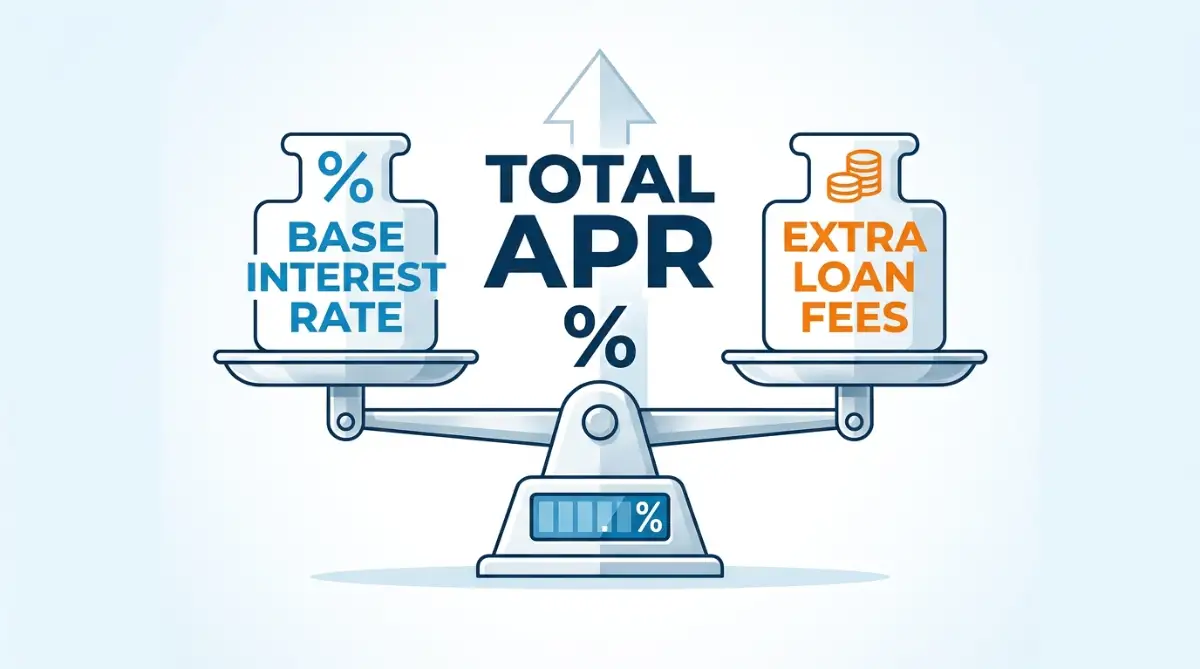
The Annual Percentage Rate gives you the complete, honest picture of your borrowing costs. It combines the base interest rate with all mandatory fees charged by the lender.
Think of APR as the total price tag at the register after taxes and fees are added. It reflects what you will actually pay over a full year for taking out the loan.
By looking at the APR, you get a realistic view of how expensive a credit card or loan really is. This makes it much easier to compare options from different banks.
Key Formula:
APR = Base Interest Rate + Loan Fees + Closing Costs + Administrative Expenses
Federal laws require lenders to disclose the APR so borrowers are not surprised by hidden charges. Always look for this number first when comparing financial products.
Side-by-Side Comparison: Base Rate vs. APR
Understanding how these two numbers differ helps you protect your personal bank account. Here is a simple breakdown to clear up the confusion:
The Sneaky Fees Hidden Inside Your APR
Lenders use various extra charges to build your final APR without raising the base rate. Being aware of these fees helps you spot bad deals quickly.
1. Origination Fees
This is a fee charged by the lender for setting up your new loan account. It usually ranges from 1% to 5% of the total loan amount.
2. Processing Charges
Banks charge this fee to cover the paperwork and background checks needed to approve your request. It might seem small, but it adds up quickly.
3. Underwriting Fees
This charge covers the cost of evaluating your credit history and verifying your financial documents. Lenders add this directly into the loan setup costs.
4. Closing Costs
Common in mortgages, these include legal charges, appraisal fees, and title insurance. These extra charges can significantly raise your final APR.
Pro Tip: Always ask your loan officer for an itemized list of all fees before signing any agreements. You can often negotiate or waive administrative processing charges.
Myth vs. Reality: Common Loan Misconceptions
Let us bust some widespread financial myths that cause people to lose money on loans.
- Myth: A loan with a lower base interest rate is always cheaper.
- Reality: A low base rate loan with high origination fees can cost more overall than a higher base rate loan with zero fees.
- Myth: APR and base rates are always different.
- Reality: If a loan has zero fees or charges, your APR and base rate will be identical.
- Myth: Credit cards only use base interest rates.
- Reality: Credit card rates are expressed as APR, which includes interest and annual maintenance charges.
Real-Life Example: Comparing Two Auto Loans
To see how this works in real life, let us compare two different car loan offers. Both loans are for $20,000 spread over a five-year period.
Loan Option A (The Flashy Advertised Deal)
- Base Interest Rate: 4.5%
- Upfront Fees: $1,200 in origination and processing fees
- Calculated APR: 6.9%
- Total Cost: Higher monthly payments due to capitalized fees
Loan Option B (The Honest Standard Deal)
- Base Interest Rate: 5.2%
- Upfront Fees: $0
- Calculated APR: 5.2%
- Total Cost: Lower overall cost despite the higher initial base rate
As you can see, Loan Option B is actually the better deal for your budget. The flashy 4.5% rate in Option A was a trap created by hidden fees.
Fixed vs. Variable Rates: How They Affect Your APR
When you shop for loans, you will encounter two main types of rate structures. Both affect your APR in different ways over time.
Fixed Interest Rates
A fixed rate stays the exact same for the entire life of your loan. Your monthly payments will never change unexpectedly, giving you peace of mind.
This makes calculating your total APR straightforward and predictable. You can plan your monthly budget years in advance without worrying about market shifts.
Variable Interest Rates
A variable rate changes periodically based on benchmark financial market indices. If market rates go up, your interest rate and monthly payment will rise too.
This means your APR can fluctuate over time. While variable rates often start lower than fixed rates, they carry higher financial risk.
Rate Comparison Summary:
• Fixed APR: Predictable Payments + Total Budget Security
• Variable APR: Lower Starting Rate + Potential Price Hikes Later
How to Calculate True Borrowing Costs Yourself
You do not need an advanced math degree to evaluate loan offers like a professional. Follow these practical steps before taking out any debt.
Step 1: Request a Loan Estimate Document
Ask your lender for a standard loan estimate form. This official document lists the APR, base rate, and every single fee in plain sight.
Step 2: Compare Total Out-of-Pocket Cash
Multiply your monthly payment by the total number of months in the loan term. Then add any upfront fees paid out of pocket.
Simple Total Cost Formula:
Total Loan Cost = (Monthly Payment × Number of Months) + Upfront Cash Fees
Step 3: Check for Prepayment Penalties
Some lenders charge extra fees if you pay off your loan balance early. Ensure your agreement allows penalty-free early repayments to save money.
Step 4: Use an Online APR Calculator
Input the loan amount, base rate, term, and total fees into an online calculator. This gives you the exact APR to compare against other offers.
Simple Checklist Before Signing Loan Papers
Before putting your signature on any contract, double-check these key items:
- Did I get the official APR in writing from the loan officer?
- Are there any hidden administrative or processing charges included?
- Is this a fixed or variable interest rate structure?
- Can I pay off this debt early without paying additional penalty fees?
- Does the monthly payment fit comfortably within my regular income budget?
By keeping these basic questions in mind, you protect yourself from predatory lending tactics. Knowing the real difference between APR and base rate puts you in complete control of your financial future.
Expert Strategies to Lower Your Borrowing Costs and Outsmart Lenders
When applying for a personal loan or mortgage, never assume that listed bank fees are set in stone. Lenders frequently tack on extra charges—such as application processing, document preparation, or underwriting fees—that can easily be reduced or eliminated if you simply ask.
I always advise borrowers to insist on a detailed line-item breakdown of all upfront costs before signing any paperwork. Pointing out an administrative charge and asking to have it waived can instantly save you hundreds of dollars right at the start.
If a lender refuses to budge on these padded fees, do not hesitate to take your business elsewhere. Bringing a competitor's written quote to the table gives you massive leverage to negotiate lower costs or get unnecessary charges completely removed.
Smart Borrower Move:
Always request an official Written Loan Estimate from at least three competing banks. Comparing these side-by-side reveals hidden administrative charges that you can challenge and eliminate before signing.
Boosting Your Credit Profile to Secure Lowest Rates
Your credit score is the single biggest factor that determines the base interest rate you receive. A higher credit score signals lower risk to banks, which means they offer you better borrowing terms.
Before applying for major credit, review your credit reports carefully for any outdated information or errors. Removing small mistakes from your credit file can boost your score by tens of points quickly.
Lowering your total credit card utilization rate below thirty percent also improves your credit rating fast. This simple adjustment often opens the door to prime rate offers with minimal fees.
Using Technology and Organization to Track Expenses
For property investors or real estate owners, keeping track of financing fees is essential for healthy cash flow. Managing multiple properties means tracking dozens of loan terms, insurance fees, and monthly tax payments simultaneously.
Many smart real estate investors streamline this process by using property management software for landlords to organize their accounts cleanly. Having clear financial visibility prevents missed payments and helps you spot excessive lender charges immediately.
When your bookkeeping is organized, you can easily evaluate whether refinancing a loan will actually save you money over time.
Leveraging Refinancing Opportunities Without Penalty
Refinancing allows you to replace an existing high-cost loan with a new loan that offers better terms. However, you must look at the new APR rather than just the new advertised interest rate.
Calculate the total fees required to close the new loan before making your final decision. If the upfront fees take five years to recover, refinancing might not make sense if you plan to move sooner.
Always confirm that your original lender does not charge a prepayment penalty for paying off your loan early. According to the Consumer Financial Protection Bureau loan guidelines, lenders must clearly disclose any early payment fees in your contract.
Strategic Prepayments to Reduce Total Compound Interest
Making extra principal payments each month is one of the most effective ways to beat high borrowing costs. Even a small extra payment reduces the underlying balance that generates interest charges.
When sending extra money to your bank, always specify that the funds should apply directly to the principal balance. This prevents the bank from treating your extra payment as an advance on next month's payment.
Over a long loan term, reducing your principal balance quickly dramatically shrinks the total interest you pay. This simple habit slashes thousands of dollars off your effective long-term costs.
Questions Borrowers Ask About Rate Calculations
Q: Can my APR change if I have a fixed-rate loan?
A: No, on a fixed-rate loan, your APR stays constant throughout the entire repayment period. Your monthly payments for principal and interest will remain steady from start to finish.
Q: Why is my credit card APR higher than my personal loan APR?
A: Credit cards are unsecured debt, meaning they do not require collateral like a house or car. Because the bank takes on higher risk, they charge higher interest rates to cover potential losses.
Q: Does paying off my loan early lower my total APR?
A: Paying off a loan early reduces the total amount of interest you pay over time. However, fixed upfront fees were already paid at closing, so your effective rate per year spent borrowing actually increases slightly.

Dangerous Borrowing Traps That Drain Your Savings
The Temptation of Short-Term Teaser Rates
One of the most dangerous marketing traps is the ultra-low introductory rate offered on credit cards or personal loans. These teaser rates often promise zero percent interest for a limited time to entice new customers.
However, once the temporary promotional period ends, the interest rate spikes dramatically. If you carry a remaining balance past the promotional deadline, you may face retroactive interest charges.
This sudden rate jump can trap unprepared borrowers in a cycle of high-interest debt that ruins their monthly budget. Always read the terms to know exactly what the APR becomes after the teaser period finishes.
The Silent Budget Killer: How Daily Compound Interest Works
Many borrowers assume that interest is calculated just once a year based on their annual percentage rate. In reality, most credit card companies and personal lenders compound interest on a daily basis.
Daily compounding means interest is charged on your original loan balance plus yesterday's unpaid interest. This small compounding trick causes your debt balance to grow much faster than basic monthly math suggests.
When you only pay the minimum required amount each month, your payment barely covers these daily interest charges. This leaves your principal balance almost completely untouched while you continue sending money to the bank month after month.
Falling for Debt Restructuring Offers Without Checking APR
When managing multiple credit cards or personal debts, combining them into a single monthly payment sounds appealing. Many companies market debt consolidation as a quick fix to lower your stress levels.
Unfortunately, some restructuring programs hide heavy administrative fees inside a lower advertised monthly payment. While your monthly bill might look smaller, the loan term extends longer, and the total APR increases.
Before signing up for any repayment plan, take time to study debunking debt consolidation myths to protect your credit history. Taking a moment to compare the overall APR ensures you do not end up paying far more over time.
Ignoring the Impact of Variable Rate Adjustments
Variable-rate loans can feel like a great deal when benchmark interest rates are low across the economy. However, economic conditions shift, and central banks regularly adjust monetary policies to control inflation.
When central banks raise rates, your variable loan rate automatically increases along with your monthly bill. According to official guidelines published by the Federal Reserve consumer financial resource standards, variable rates adjust periodically based on market indices.
Borrowers who stretch their monthly budgets to the limit on a variable rate leave zero margin for error. A small increase in market rates can instantly push your monthly payment past what you can afford.
Do's and Don'ts of Smart Borrowing
To keep your personal finances safe, follow these clear rules whenever you need credit:
- DO ask every lender for a written statement showing the exact APR and fee schedule.
- DO compare total repayment amounts over the life of the loan rather than just monthly bills.
- DO make extra principal payments whenever your monthly budget allows.
- DON'T choose a loan based solely on a flashy advertised interest rate on television or online.
- DON'T ignore prepayment penalty clauses in mortgage or auto loan contracts.
- DON'T take out variable-rate loans if your monthly income cannot handle rate increases.
Real-Life Scenario: The True Cost of Borrowing $10,000
Let us look at how small fees change the real cost of borrowing money. Imagine two friends, Alex and Jordan, who each borrow $10,000 for home repairs over three years.
Alex picks a bank advertising a simple 6% interest rate with zero setup fees. His APR is exactly 6%, and his total interest paid over three years comes out to about $965.
Jordan picks another bank advertising a 5% interest rate, but the contract includes $600 in origination and processing fees. Because those upfront fees are added to his total borrowing cost, his real APR jumps to nearly 9%.
When the three years are up, Jordan ends up spending significantly more cash than Alex. Jordan paid more money overall simply because he focused on the headline interest rate instead of calculating the APR.
Your Personal Roadmap to Financial Freedom and Smart Lending
Three Steps You Can Take Right Now
Taking control of your personal finances starts with simple, actionable steps that you can implement today. You do not need complex tools or financial degrees to protect your hard-earned money.
First, gather all your current credit card and loan statements to find the true APR listed on each document. Group them by their total annual costs so you know which debts require immediate attention.
Second, call your existing credit card providers and request a lower interest rate based on your good payment history. Many financial institutions quietly lower rates for loyal customers who simply take the time to ask.
Third, commit to comparing at least three competing loan offers whenever you need to borrow money in the future. Always insist on seeing the full loan estimate disclosure before signing any final contracts.
A Final Thought on Financial Freedom
Understanding the true mechanics of interest rates gives you an incredible advantage in the financial world. You no longer have to rely on bank advertisements or guess what your monthly payments will look like.
Knowledge is your strongest defense against hidden fees and misleading interest quotes. When you focus on total annual costs rather than catchy headline rates, you protect your wealth and build long-term financial security.
Take charge of your financial journey today by reviewing your loan agreements with fresh eyes and renewed confidence!
Financial & Information Disclaimer
Disclaimer: The content provided in this article is for educational and informational purposes only and does not constitute formal financial, legal, or investment advice. Borrowing terms, annual percentage rates (APR), and lender fees vary based on individual credit profiles, geographic locations, and financial institutions. Always consult with a qualified financial advisor or certified professional before entering into binding loan agreements or making major personal finance decisions.